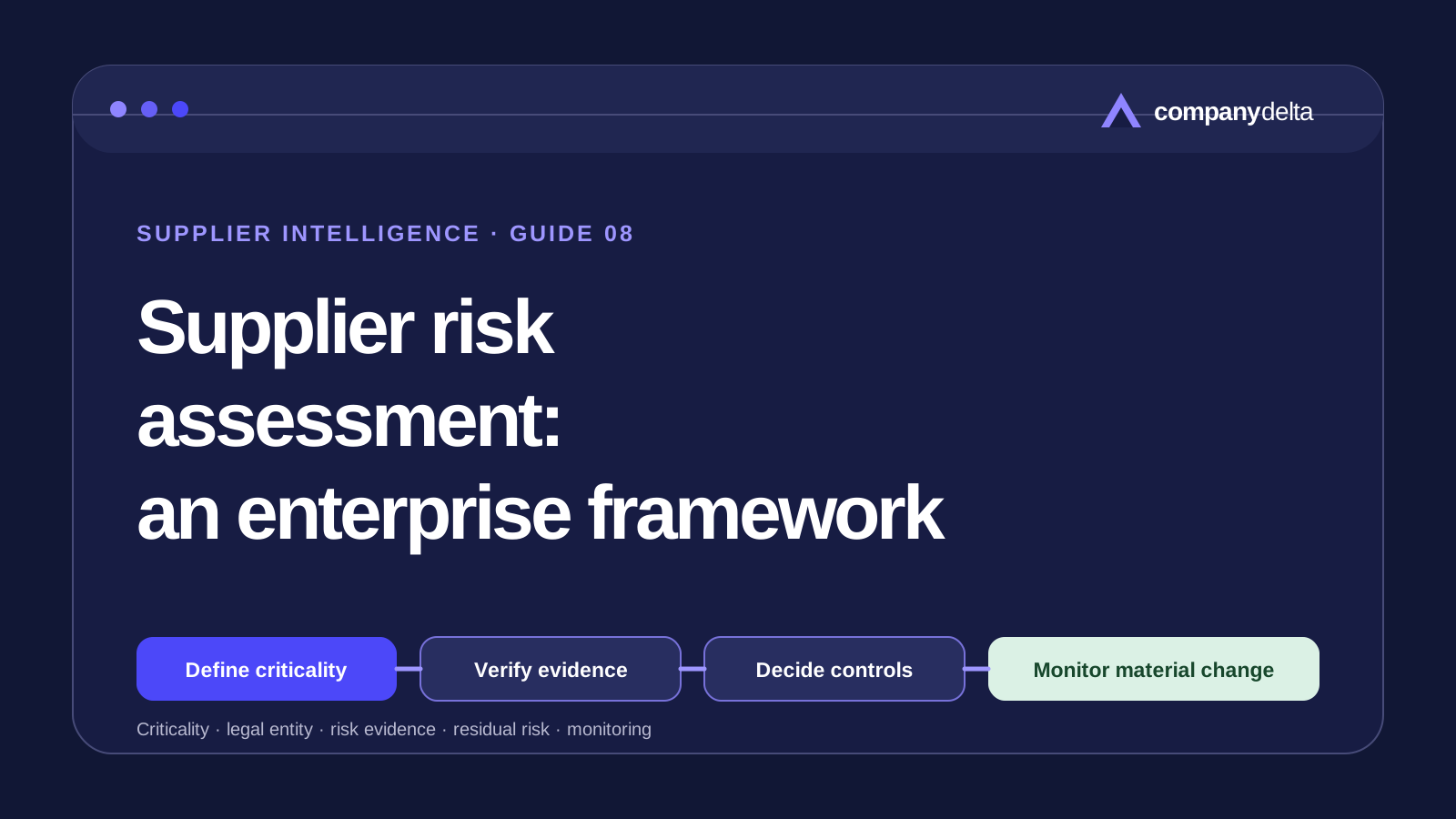
A supplier risk assessment is a structured evaluation of the harm that could arise from using a specific supplier for a specific purpose, the evidence available about that exposure and the controls needed before and during the relationship.
The last five words matter. The same company can be a low-risk office-supplies vendor and a critical technology provider. A supplier is not “high risk” in the abstract. Risk depends on what the supplier will do, which entity signs the contract, what systems or data it can access, how difficult it is to replace and what would happen if it failed.
A useful assessment separates four concepts that are often collapsed into one score:
- Criticality: the importance of the product or service to your organisation and the consequence of interruption.
- Inherent risk: the exposure before contractual, technical, financial or operational controls are applied.
- Evidence confidence: how reliably the identity, ownership, status, finances and other relevant facts have been established.
- Residual risk: the exposure that remains after controls and mitigations are considered.
“Supplier risk assessment” and “vendor risk assessment” usually describe the same procurement control. “Third-party risk assessment” is broader and can include distributors, agents, customers, partners, contractors and other external relationships. Use the terminology your organisation recognises, but define the population and accountable owner so cases do not fall between functions.
Keeping them separate prevents a common failure: allowing a strong questionnaire response or a polished supplier brand to offset an unresolved legal entity. Before risk can be assessed, the team must know which company it is assessing. The contracting party, payment entity, service operator and parent may be different organisations.
A reproducible decision
Another reviewer should be able to identify the entity, see the evidence, understand the open questions and reproduce the policy outcome.
Certainty from a single score
A score can prioritise work. It cannot prove that missing ownership, stale financials or an unmatched company record are harmless.
Use a four-layer assessment model
Most weak supplier assessments start with a long questionnaire. A stronger model starts with the decision and builds four connected layers: business dependency, legal-entity identity, risk evidence and decision controls. Each layer answers a different question and has a different owner.
Four layers turn supplier information into a decision
Assessment modelA supplier cannot be assessed reliably if the relationship is undefined or the legal entity is unresolved. Evidence and controls sit on top of those foundations.
Business dependency normally belongs with procurement and the business owner. They define the service, data or system access, expected spend, geographic reach, subcontracting, alternatives and recovery tolerance. This determines assessment depth.
Legal-entity identity should connect the requested supplier to an official company record. Capture the registered name, jurisdiction and company registration number. If the supplier uses a trading name, document the link rather than silently treating the brand as the legal party. Where records conflict, use a controlled entity-resolution process and return ambiguous candidates for review.
Risk evidence brings together only the domains relevant to the proposed relationship. A supplier handling personal data needs a different review from a logistics provider or a marketing agency. Evidence should be dated, scoped to the correct entity and classified as verified, supplier-provided, inferred or unavailable.
Decision and controls translate findings into an accountable outcome. The record should show who approved, which policy rule applied, which conditions remain open and what event will trigger reassessment.
Match each risk domain to evidence it can actually support
A supplier risk assessment is not a search for every possible fact. It is a search for evidence that can change the decision. Start with the risk domains created by the relationship, then identify the source, freshness and limitations of each item.
| Risk domain | Useful evidence | Important limitation |
|---|---|---|
| Identity and status | Registry identifier, entity type, current status, address, filing dates | Registration does not prove operational capability or payment-account ownership |
| Ownership and control | Direct shareholders, group relationships, control filings, beneficial owners | Disclosure thresholds and availability vary; missing data is not proof of no owner |
| Financial resilience | Accounts, filing history, capital, insolvency indicators, credit context | Accounts may be old, abbreviated, consolidated or filed for a different group entity |
| Compliance and integrity | Resolved-entity screening, licences, enforcement records, declarations | Name-only matches can create false positives; absence of a match is not universal clearance |
| Cyber and data | Architecture, control testing, certifications, incident process, subprocessors | A certificate covers a stated scope and period, not every service or future control state |
| Operational resilience | Locations, capacity, continuity plans, insurance, dependencies and recovery evidence | Self-reported plans require challenge and may not prove tested recovery capability |
| Concentration | Spend, common parents, shared sites, subcontractors, product dependencies | Corporate linkage alone does not quantify operational dependency |
| Jurisdiction and geopolitics | Incorporation, operations, ownership, trade routes and regulatory exposure | Country risk should not replace entity-specific evidence or proportional review |
Evidence coverage should be visible, not averaged away
Coverage mapThe example does not calculate an overall score. It shows which claims are supported, which need review and which remain unknown.
Source lineage matters because apparently equivalent fields can mean different things. Record whether a status comes from an official registry, a supplier document or a data provider; when it was retrieved; and which entity it describes. For ownership, preserve the relationship path and calculation rather than only the final name. The beneficial-owner review should make control, indirect ownership and unresolved gaps explicit.
Do not treat unavailable information as a zero. A jurisdiction may not publish financial statements or shareholder data. A newly incorporated company may have no filing history. A system may have failed to retrieve a record. These situations require different follow-up actions and should remain distinguishable in the case record.
Run the supplier risk assessment in seven steps
1. Define the decision and the relationship
State what is being purchased, which business owner is accountable, which countries are involved, what access the supplier receives and what failure would affect. Define the decision deadline, required approvers and policy version. Without this scope, reviewers either over-collect information or miss material exposure.
2. Assign a criticality tier
Tier suppliers using business impact, not prestige or company size. Consider revenue interruption, customer harm, safety, regulated activity, data sensitivity, recovery time, substitutability and concentration. Record the reason for the tier so similar relationships can be treated consistently.
3. Resolve the legal entity and related parties
Match the supplier to a registry record using jurisdiction and identifier. Confirm status and relevant directors or officers. Map immediate and ultimate corporate relationships where needed. If the contract, invoice or payment request names a different entity, stop and resolve the difference before proceeding.
4. Collect proportionate evidence
Use the criticality tier and relationship scope to select evidence. Low-impact purchases may need core identity and payment controls. A critical provider may require deeper ownership, financial, cyber, resilience, subcontractor and concentration review. Use the existing supplier due-diligence checklist for the company-record layer, then add the domain-specific controls the service requires.
5. Record findings and confidence separately
A finding describes what the evidence indicates. Confidence describes the quality and completeness of the evidence. “Financial pressure indicated by recent filings” is not the same as “financial evidence unavailable.” Both may trigger action, but they should not share a reason code.
6. Apply decision rules and mitigations
Possible outcomes include approve, approve with conditions, escalate, pause or decline. Conditions might include a parent guarantee, shorter term, staged payment, alternative supplier, additional security control, evidence deadline or executive acceptance. Every condition needs an owner and due date.
7. Activate monitoring and review
Define which changes reopen the assessment: company status, ownership, directors, financial filings, sanctions context, address, payment details, cyber incidents, service scope or subcontractors. A bank-detail or payment-entity change should follow a separately controlled verification path and should never be accepted only because the supplier passed the original assessment. Monitoring should route a material event to the right owner rather than merely create an alert.
Minimum decision record
The completed case should retain the supplier’s legal name, jurisdiction and identifier; the relationship and criticality rationale; risk domains reviewed; evidence source, scope and date; findings and confidence; unresolved gaps; hard-stop checks; mitigations, owners and due dates; inherent and residual risk; final outcome; approvers; monitoring triggers; and the next review condition. A dashboard status without that underlying record is not an auditable assessment.
Do not confuse supplier risk with supplier criticality
Criticality tells you how much the relationship matters. Risk findings tell you what may go wrong. Combining both dimensions helps allocate review effort without pretending that one number is the truth.
Criticality and risk findings lead to different actions
Illustrative matrixA critical supplier with few negative findings still needs resilience planning. A non-critical supplier with serious integrity findings may still require escalation or rejection.
Scores can help rank a queue, but they create three risks. First, weighted averages can allow a strong result in one domain to cancel a hard stop in another. Second, they imply precision that the evidence may not support. Third, a formula may conceal who accepted an exception. Preserve domain findings, evidence confidence, hard-stop rules and final judgement alongside any score.
Worked example: assessing a critical software supplier
This example is illustrative. The company, facts and outcome are invented to demonstrate the method; they are not statistics or a recommendation about a real supplier.
A procurement team plans to use Northstar Workflow Ltd for a customer-support platform. The service will process contact details, integrate with the identity provider and support a time-sensitive operation. Replacement would take several months. The relationship is therefore classified as high criticality before the supplier’s risk evidence is reviewed.
- Identity: the registry number and jurisdiction match the contracting entity. The proposal uses the same legal name. Confidence is high.
- Ownership: a direct corporate shareholder is visible, but the ultimate ownership path becomes unavailable in a second jurisdiction. The gap is recorded rather than interpreted as no controlling owner.
- Financials: the latest available accounts are for the contracting entity, but the period predates a significant expansion described by the supplier. The evidence is valid but not sufficient on its own to establish current resilience.
- Cyber and data: the supplier provides a current assurance report covering the relevant service, while one planned subprocessor has not completed review.
- Operational resilience: a continuity plan exists, but the recovery test has not covered failure of the primary hosting region.
The team does not average those facts into an unexplained “medium” score. It records an approve with conditions outcome: complete the subprocessor review before production access, test regional recovery by a defined date, obtain updated financial evidence, and escalate the unresolved ownership path to compliance. Procurement also retains a transition plan because the supplier is critical.
The example shows why approval and evidence confidence are different. The supplier can be approved under controlled conditions even though not every field is complete. Equally, a complete questionnaire would not remove the need for independent identity and ownership checks.
Turn the assessment into an ongoing control
A point-in-time review begins to age as soon as the supplier is approved. Company status can change, ownership can be reorganised, directors can move, new accounts can be filed and the business relationship itself can expand. A supplier initially approved for a low-impact service may later receive data access or become operationally critical.
Build a monitoring plan from the original decision:
- map each material event to the risk domain it affects;
- define a severity rule and evidence requirement;
- name the reviewer and escalation path;
- set a response target based on criticality;
- retain the previous and current value, source date and decision;
- monitor failed retrievals and unmatched entities as control failures, not silence.
Every material change needs a controlled route
Review loopMonitoring is complete only when the change is linked to the correct supplier, assessed against the approval baseline and closed with a documented outcome.
Use the supplier monitoring guide to design event rules and review ownership. Reassess when a change affects the original decision, evidence expires, the relationship changes materially or a periodic review becomes due. Do not re-run every check at the same frequency simply because the system can.
Measure the control, not just its throughput. Useful measures include unmatched supplier records, assessments returned for clarification, open high-criticality conditions, overdue mitigations, alert-to-review time, repeated false positives and monitoring failures. Break results down by business unit, country, risk domain and criticality so a comfortable average does not hide a weak control.
Privacy and proportionality remain part of the design. Collect information that is relevant to the business decision, restrict access, define retention, provide a correction route and keep accountable human review where a finding could materially affect a supplier.
Supplier risk assessment questions answered
What is a supplier risk assessment?
It is a structured evaluation of the harm that could arise from using a specific supplier for a specific purpose, the evidence available about that exposure and the controls required before and during the relationship.
What is the difference between supplier risk and supplier criticality?
Criticality measures how important the relationship is and the consequence of failure. Supplier risk describes the relevant exposures and findings. A critical supplier can have few negative findings but still require strong continuity and exit planning.
Is a vendor risk assessment different from a supplier risk assessment?
Usually not. Procurement teams often use vendor and supplier interchangeably. Third-party risk is broader and may include agents, partners, contractors or customers. What matters is a defined population, consistent policy and clear ownership.
What should a supplier risk assessment include?
It should include relationship scope, criticality, resolved legal identity, relevant risk domains, evidence and limitations, inherent and residual risk, mitigations, approval, review owners and monitoring triggers.
How do you assess a new supplier?
Define the service and impact, assign criticality, resolve the legal entity, collect proportionate evidence, record findings and confidence separately, apply decision rules, assign mitigations and activate monitoring.
Which supplier risk categories should be reviewed?
Only categories relevant to the relationship. Common domains include identity, ownership, financial resilience, compliance, cyber, privacy, operational continuity, concentration, jurisdiction and sustainability or human-rights exposure.
Should supplier risk be reduced to one score?
A score can prioritise cases, but it should not replace domain findings, hard-stop rules, evidence confidence or accountable judgement. Weighted averages can conceal a material issue or an unresolved evidence gap.
How often should supplier risk be reassessed?
Use event-driven reassessment when a material company or relationship change occurs, plus periodic review where policy requires it. Frequency should reflect criticality, exposure, evidence expiry and the rate at which relevant facts can change.
What happens when supplier information is unavailable?
Record what is missing, why it may be unavailable and how it affects the decision. Seek alternative evidence where proportionate, then follow the defined route for clarification, conditional approval, escalation, pause or decline.
Can supplier risk assessments be automated?
Entity matching, registry retrieval, evidence collection, questionnaires, screening, monitoring and routing can be automated. Ambiguous identities, material conflicts, policy exceptions and acceptance of residual risk require accountable human review.
How is a supplier risk assessment different from supplier due diligence?
Due diligence is the research and verification used to establish relevant facts. The risk assessment combines that evidence with the relationship’s criticality, policy rules, mitigations and approval decision. The two processes should connect but are not interchangeable.
Assess the right supplier—and keep the decision current.
Resolve legal entities, investigate ownership and company records, then route material changes back to the responsible reviewer.