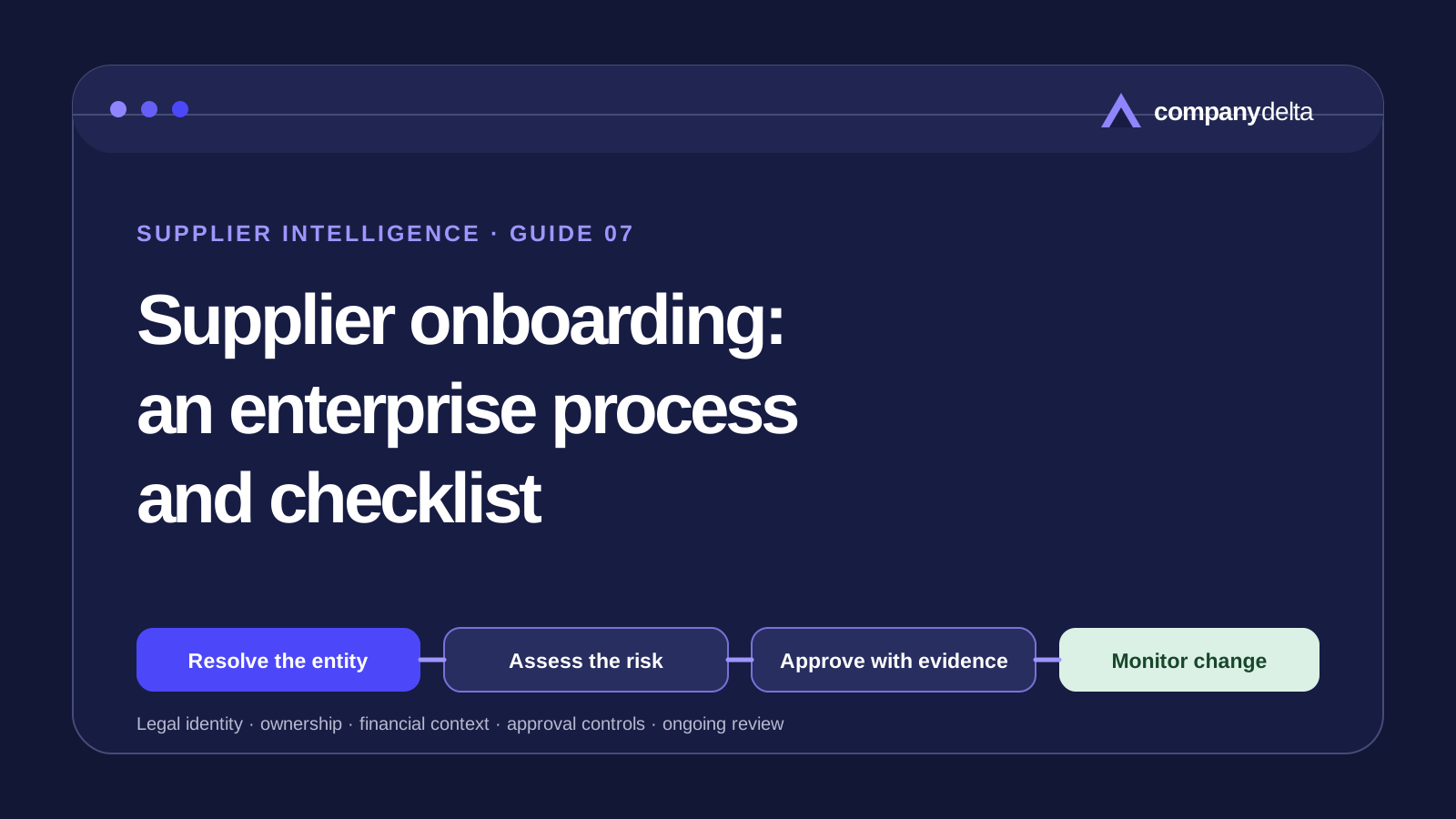
Supplier onboarding is the controlled process of identifying a proposed supplier, validating the legal and payment entity, collecting the evidence required by policy, assessing relevant risks, approving the relationship and creating a reliable record in procurement and finance systems.
The process is often reduced to a form: company name, bank details, tax number and an internal approver. That creates speed only on the visible path. The hidden cost appears later when the contract names one entity, the invoice comes from another, the bank account cannot be tied to either, or a material ownership or status change is missed after approval.
Enterprise onboarding therefore has to answer five separate questions:
- Identity: which legal entity are we contracting with and paying?
- Authority: who can provide information and commit that entity?
- Suitability: can the supplier perform the intended role and withstand the exposure?
- Risk: which ownership, compliance, financial, geographic or operational factors require treatment?
- Continuity: what must be monitored after approval?
Supplier onboarding is not the same as vendor master creation. The master record is an operational output. It is also not identical to KYB. KYB verification is an important identity and ownership layer, but procurement may also need information about criticality, concentration, insurance, information security, service continuity, tax, payment controls and contract obligations.
Create one evidence-backed supplier identity
Connect the contracting entity, payment entity, identifiers, risk tier, approvals and review conditions in a record another team can reproduce.
Turn missing data into a false pass
A field can be unavailable because of jurisdiction, source delay, access restrictions or supplier non-response. Record the gap and its decision impact.
Supplier onboarding is a sequence of evidence gates
Process mapEach gate has an owner and exit condition. A supplier should not reach the payment master merely because a questionnaire was submitted.
Define the risk scope before asking for documents
A universal questionnaire feels consistent but is rarely proportionate. It burdens low-risk suppliers, creates review backlogs and still misses questions that matter for critical relationships. Start with the intended relationship and let that determine the evidence.
Useful scoping factors include expected spend, access to systems or personal data, operational criticality, substitutability, jurisdictions of operation, subcontracting, payment method, regulated activity, product safety, intellectual property access and the consequence of failure. These factors should be recorded before the supplier is asked to submit information.
Risk tiering must not be confused with a supplier score. A tier decides the depth of due diligence and approval. A finding records what the evidence says. The approval decision applies policy to those findings in the context of the relationship. Keeping those concepts separate makes later review possible.
| Relationship characteristic | Why it matters | Possible additional review |
|---|---|---|
| Critical service or single source | Failure can interrupt revenue, operations or customer service | Financial resilience, continuity, dependencies and alternatives |
| Data or system access | The supplier may create privacy, cyber or access-control exposure | Security assessment, subprocessors, incident and termination controls |
| Cross-border payment | Entity, tax, bank and sanctions context may span jurisdictions | Payment-entity alignment, ownership, tax and geographic review |
| Use of subcontractors | Delivery and risk may sit beyond the named supplier | Material subcontractors, approval rights and flow-down obligations |
| Low-value standard purchase | Heavy review may cost more than the exposure it controls | Core identity and payment controls with defined exception triggers |
Document the reason for the tier. Procurement should be able to explain why two suppliers were asked for different evidence. Compliance and audit teams should be able to see which policy version created the requirement. Suppliers should be told what information is needed, why it is needed and what happens if it is unavailable.
Build the supplier record from evidence, not self-declaration alone
Supplier-provided information is necessary, but it is a claim until it is linked to independent evidence. Begin with the legal company name, registration number and incorporation jurisdiction. Resolve that combination against the relevant corporate register and retain the source, retrieval date and any filing date.
The company registration number should remain scoped to its issuing jurisdiction. Names, trading styles, tax identifiers and domains can help matching, but none should silently replace the legal-entity key. If several candidates remain, return them for clarification rather than selecting the nearest name.
A proportionate evidence set can cover:
- legal identity: registered name, number, jurisdiction, entity type, status and registered address;
- corporate authority: relevant directors, officers, representatives or delegated signatories;
- ownership and control: immediate ownership, group relationships and beneficial owners where policy requires it;
- screening context: applicable sanctions, politically exposed person, enforcement or adverse-information checks, each tied to a resolved company or person rather than a name alone;
- financial context: available filings, accounts, insolvency indicators and the age and scope of the evidence;
- payment setup: bank-account evidence, payee-name alignment, tax status and controls over later changes;
- operational evidence: insurance, licences, certifications, security documentation and continuity information appropriate to the service;
- decision record: findings, exceptions, approvers, conditions, timestamps and the next review trigger.
Documents do not all prove the same thing. A certificate of incorporation can support formation but may not establish current status. A registry extract may show current registered facts but not bank ownership. Audited accounts may cover a different group entity from the proposed supplier. Always state what each document can and cannot establish.
Match each onboarding claim to the right evidence
Evidence matrixEvidence should be attached to a specific claim. A strong document in one category cannot compensate for a missing control in another.
A practical enterprise supplier onboarding process
Open a controlled request
The internal sponsor records the business need, product or service, spend, criticality, data access, operating countries and proposed contract owner. Duplicate requests should be linked before the supplier is contacted.
Resolve the legal entity
Ask for the legal name, registration number and jurisdiction, then validate them independently. Keep trading names and group companies as relationships, not substitutes. Use conservative entity resolution when the evidence conflicts.
Assign the risk tier
Apply the approved scoping rules to the intended relationship. Record why the tier applies and which evidence, reviewers and approvals it triggers. Prevent requesters from lowering a tier simply to accelerate onboarding.
Collect once, validate separately
Use a structured supplier request, but validate material claims against authoritative or independent sources. Reuse current evidence across authorised teams instead of asking the supplier for the same document repeatedly.
Review ownership, management and financial context
Trace relevant group and ownership relationships, verify the people or roles required by policy and inspect available financial evidence for the correct entity. A parent’s strength should not automatically be attributed to a subsidiary without support.
Reconcile contract, invoice and payment entities
Make differences explicit. They may be legitimate within a group, but the relationship and authority need evidence. Apply dual control to bank-account creation and changes; never treat an email instruction as sufficient proof.
Decide, condition or escalate
Give reviewers the findings, source dates, unresolved gaps and policy rule. Possible outcomes should include approved, approved with conditions, pending evidence, escalated and rejected—with a reason and accountable owner.
Activate monitoring and review dates
Set event triggers for company status, ownership, directors, registered details and new filings where relevant. Add periodic reviews for controls that cannot be monitored through events. The separate supplier monitoring guide covers alert design after approval.
Store the resolved entity, registration key, risk tier, evidence used, unresolved limitations, policy version, outcome, conditions, approvers, effective date and monitoring rule. A screenshot without source context is not an audit trail.
Route exceptions instead of forcing every case into pass or fail
Real supplier data is incomplete. A private company may not publish detailed accounts. A jurisdiction may restrict shareholder access. A new entity may have no trading history. A global group may contract locally but invoice centrally. These facts do not automatically prove high risk or low risk; they change what can be concluded.
A defensible process distinguishes four outcomes:
- Approve
- The required evidence supports the entity and policy conditions, with no unresolved issue that blocks the proposed relationship.
- Approve with conditions
- The relationship can proceed subject to a control such as a spend limit, guarantee, milestone payment, enhanced monitoring or time-bound evidence request.
- Hold and investigate
- A material conflict or gap requires clarification, deeper research or specialist review before approval.
- Reject
- The evidence or supplier response conflicts with an explicit policy rule, risk appetite or legal restriction, and the rationale is documented.
Do not design escalation as an unowned mailbox. Every exception category needs a decision owner, target response time, evidence requirement and fallback. Procurement should know whether it can negotiate a mitigation. Finance should know whether payment setup is blocked. The requester should see a meaningful status, not “compliance review.”
Use evidence quality and relationship exposure together
Illustrative modelA data gap has different consequences for an incidental purchase and a single-source critical service. Policy should connect both dimensions to a defined route.
Automate collection and routing without hiding uncertainty
Automation creates value when it removes repeated retrieval, normalises evidence and routes cases. It creates risk when it converts “not found” into “no risk,” merges related legal entities or lets a composite score conceal contradictory facts.
Good candidates for automation include entity matching from jurisdiction-scoped identifiers, registry retrieval, extraction of dated fields, duplicate detection, policy-driven request lists, expiry reminders, change detection and case routing. Human review remains necessary where identity is ambiguous, ownership paths are incomplete, adverse information concerns a possible namesake, the policy requires judgement or the commercial mitigation needs negotiation.
For each automated result, preserve the input, source, retrieval time, transformation, rule version and reason. A reviewer should be able to see why a case was routed and correct a wrong match. If a source is unavailable, return an explicit coverage or retrieval status; do not silently recycle stale data.
Integrations should write stable identifiers and evidence references into procurement, ERP and vendor-management systems. Use APIs for controlled retrieval and webhooks for relevant changes. Keep business approval in the system that owns the decision, while linking back to the evidence rather than copying an unexplained label.
Measure control quality as well as onboarding speed
Cycle time matters, but reducing it is not the same as improving onboarding. A fast process can simply defer unresolved problems to accounts payable, audit or incident response. Measure both flow and evidence quality.
- Time to first complete submission
- Separates supplier response and request quality from internal review time.
- Entity-resolution exception rate
- Shows how often proposed suppliers cannot be matched confidently to one legal entity.
- Evidence reuse rate
- Measures whether current, approved evidence is reused instead of repeatedly requested.
- Manual review by reason
- Reveals whether workload comes from genuine risk, poor forms, source gaps or avoidable matching failures.
- Conditional approval closure
- Tracks whether promised documents and mitigations are completed by the agreed deadline.
- Post-approval change coverage
- Shows which approved suppliers have active, successful monitoring for policy-relevant events.
Break metrics down by country, business unit, supplier tier and reason code. An overall average can hide a serious delay in high-risk reviews or persistent entity-matching problems in one jurisdiction. Do not set a universal benchmark without understanding the underlying mix.
Governance should also cover data minimisation, access, retention and correction. Public company information can still be personal or commercially sensitive. Collect what the decision requires, restrict who can see it and provide a route to correct an inaccurate match or outdated conclusion.
Supplier onboarding questions answered
What is supplier onboarding?
Supplier onboarding is the controlled process of identifying a supplier, validating its legal and payment entity, collecting required evidence, assessing relevant risks, approving the relationship and creating a reliable operational record.
What is the difference between supplier onboarding and vendor onboarding?
The terms are often used interchangeably. Some organisations use “supplier” for providers of goods and services and “vendor” mainly for the payment master. Whatever the terminology, define one process owner and one legal-entity identity.
What documents are needed for supplier onboarding?
The answer depends on the relationship and jurisdiction. Common evidence covers registration, tax, ownership or authority, bank details, insurance, licences, security and financial information. Each document should be tied to a specific claim and policy requirement.
How do you verify a new supplier?
Start with legal name, registration number and jurisdiction, resolve the company against the appropriate registry, confirm its status and relevant management or ownership, then apply the financial, payment, compliance and operational checks required by the risk tier.
Who owns the supplier onboarding process?
Ownership is usually shared: procurement owns the commercial request, business risk owners assess domain-specific issues, compliance or legal handles relevant regulatory questions, and finance controls payment setup. One role should own the end-to-end case and status.
How long should supplier onboarding take?
There is no reliable universal duration. It depends on supplier responsiveness, relationship complexity, jurisdiction, evidence availability and approval depth. Measure each stage separately instead of hiding delays inside one average.
Can supplier onboarding be automated?
Collection, entity matching, registry retrieval, document extraction, reminders, monitoring and routing can be automated. Ambiguous identities, material conflicts, policy judgement and commercial mitigations should retain an accountable human review path.
What should happen when supplier information is missing?
Record what is missing, why it may be unavailable, how material it is and which policy route applies. The outcome may be a clarification request, alternative evidence, conditional approval, escalation or rejection. Missing data should never become an automatic pass.
When should a supplier be re-onboarded?
Reassessment may be required after a material ownership, status, service, payment, jurisdiction, control or risk change, when evidence expires, or at a policy-defined periodic review. Use event monitoring where the underlying source can change between reviews.
How is supplier onboarding different from supplier monitoring?
Onboarding establishes the baseline identity, evidence, risk tier and approval before the relationship begins. Monitoring checks for relevant changes after approval and routes them back into review.
Onboard the right legal entity—and keep the evidence current.
Resolve supplier identities, investigate ownership and company records, then monitor the changes that can alter the approval.